
Presentation of the five-year project
Following on from the 2015-2019 project, the ZAL's work will enable us to develop research and monitoring of the socio-ecosystems (SES) of the Loire in order to improve our knowledge of how they function and to encourage the transfer of this knowledge to the various stakeholders in the region..The aim of the research will be to study the components of the Loire system and to understand how the system works in three areas thematic groups and according to the two gradients identified.
The studies are envisaged on different scales of time and space. The structuring of the research integrates the conceptual scheme while preserving the temporal dimension, and in particular the long term, a strong specificity of the ZAL since its creation.
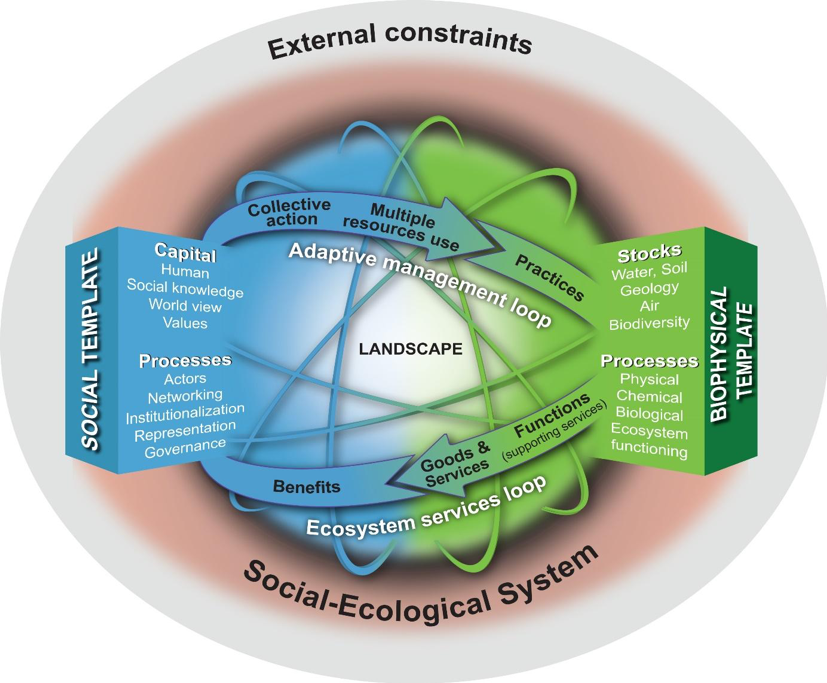
The transfer of information, communication and exchanges with local stakeholders are at the heart of the ZAL's concerns. By disseminating the knowledge and forward-looking modelling produced by research to managers and decision-makers, the ZAL provides the scientific information needed for decision-making on environmental and biodiversity management, regional planning and public policy.
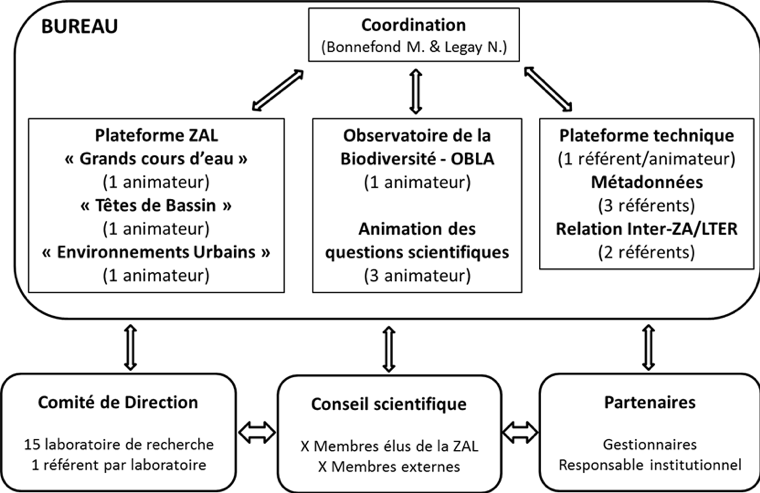
Governance of the ZAL will be organised on 5 levels:
- A Co-directed by made up of a coordinator from the previous contract (Mathieu Bonnefond) and a new coordinator (Nicolas Legay). Both will be responsible for managing the Zone Atelier, i.e. coordinating the task leaders, members and events, managing the budget and contacts with research structures, the InterZA, the LTER network and institutional partners.
- A Officecorresponding to the entertainment teammade up of members in charge of scientific coordination (3 members), coordination of platforms and the observatory (4 members), work on metadata (3 members) and interaction with the RZA (1 member). The coordinators will assist those in charge of these tasks and will also be responsible for monitoring the setting up of the eLTER network and running the website (see Figure 7). This will ensure that the main scientific fields are represented and that day-to-day management is efficient. The role of this structure will be to draw up budget proposals; to draft and circulate the annual report; and to call on experts for specific actions such as formulating and evaluating responses to internal calls for projects.
- Le Executive Committee is made up of representatives from the member laboratories. It is responsible for scientific proposals and participates in assessments. It approves decisions taken by the Executive Committee. Steering Committee meetings will be held regularly (3 to 4 times a year) to circulate calls for research projects, review current projects, plan expenditure and organise seminars.
- L'Annual General Meeting made up of ZAL members and key partners. It validates the ZAL's annual scientific activity report and participates in the development of the project, which includes research activities and the transfer of knowledge to stakeholders. The general operation of the ZAL is discussed at the Annual General Meeting.annual general meeting. It also discusses the budget proposals of the Board and the Executive Committee, the general operation and policy of the ZAL, its place in the local academic landscape and its presence in national and international calls for projects.
- A Scientific Advisory Boardwill be set up in the first two years of the contract and will discuss the ZAL's scientific policy (selection of projects funded under the Internal Call for Projects, etc.) and will be made up of members elected by and from among the members of the ZAL and external members appointed by the Management Committee (researchers and extra-academic experts).
 English
  French