
What is an "atelier" zone?
Parce que
The Research Observatory Network
The "Zones Ateliers" (ZA) are centred around a functional unit (a river and its catchment area, landscapes – agricultural or urban – and biodiversity, from the Antarctic to sub-Saharan Africa, or the coast, or even life in environments characterised by chronic natural or naturally enhanced radiation) and develop a specific scientific approach there, based on observations and experiments at workshop sites, to conduct long-term multidisciplinary research. A ZA is therefore, most often, a network of workshop sites.
The ZAs are organised nationally in network, the Network of French Research Observatories (RZA)It allows us to study, on often nested timescales and spatial scales and in different territories, the complex relationships between human activities and ecosystem functioning. The RZA is recognised as a Research Infrastructure by the CNRS (INEE) and is labelled by the National Research Alliance for the Environment (ALLENBY), Long-Term Environmental Research Observation and Experimentation System: SOERE RZA.
Olivier Ragueneau He has been in charge of the IR Directorate since 1 January 2021, he is the contact person for INEE (the IR's supervisory body) and ALLENVI, and is responsible for the conduct of ZA evaluations.
The workshop area network is a member of LTER Europe and of Filter for international.
For multidisciplinary research on socio-ecosystems
The Atelier Sites (ZA) focus on a functional unit (a river and its watershed, landscapes – agricultural or urban – and biodiversity, from the Antarctic to sub-Saharan Africa, or the coast, or environments characterised by chronic natural or amplified natural radiation) and develop a specific scientific approach based on observations and experiments at workshop sites, in order to conduct multidisciplinary research in the long term. A ZA is therefore, most often, a network of workshop sites
The ZAs place ecosystems (marine, mountain, agricultural, riverine etc.) at the centre of the system, considering as much theobservation thatanalyseand theexperimentationor else the human practices on these environments, but also the eco-friendly features such as, for example, ecosystem services. They are in direct contact with the stakeholders of this territory and particularly the questions emerging from the world of managers, politicians, and associations.
Understanding these interactions involves a multidisciplinary approach, including in particular natural sciences, life sciences, human sciences and engineering sciences, with the aim of responding to a specific territorial question that can be developed in interaction with managers.
All the business parkscurrently numbering 14, offers a diversity of contrasting and complementary situations from the point of view of social environments and systems.
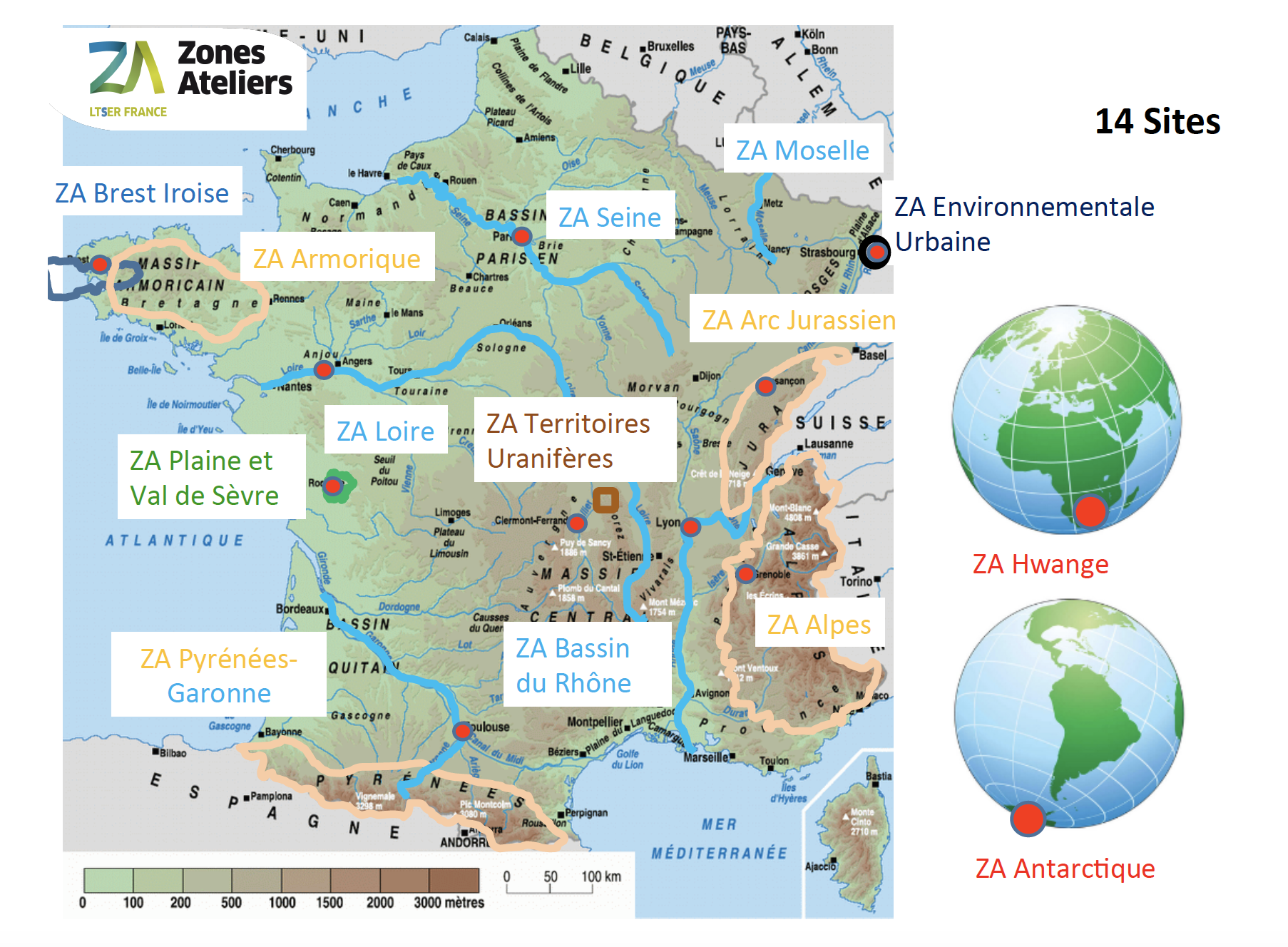
Industrial estates according to natural environments and social systems studied
– The great rivers You large rivers and their catchment area: For the Seine, FR Loire, Rhône River Basin, ZA Moselle
– The landscapes according to a climatic and anthropogenic gradient: Antarctica, ZA Alps, Jura Regional Park, Armorica, For Plain and Val de Sèvre, Urban Environmental Department, For Hwange, FOR ME
– The Land/Sea Interface : FC Brest-Iroise
– Ecology, society and natural radioactivity : Uranium-Bearing Territories
The ZAs are organised nationally in network, the Network of Environmental Research Observatories, It allows the study, over often nested time and space scales and across different territories, of the complex relationships between human activities and the functioning of ecosystems.
The "Zones Ateliers" network is a member of LTER Europe and of Filter for international.
Hello.
The Research Observatory Network
The "Zones Ateliers" (ZA) are centred around a functional unit (a river and its catchment area, landscapes – agricultural or urban – and biodiversity, from the Antarctic to sub-Saharan Africa, or the coast, or even life in environments characterised by chronic natural or naturally enhanced radiation) and develop a specific scientific approach there, based on observations and experiments at workshop sites, to conduct long-term multidisciplinary research. A ZA is therefore, most often, a network of workshop sites.
The ZAs are organised nationally in network, the Network of French Research Observatories (RZA)It allows us to study, on often nested timescales and spatial scales and in different territories, the complex relationships between human activities and ecosystem functioning. The RZA is recognised as a Research Infrastructure by the CNRS (INEE) and is labelled by the National Research Alliance for the Environment (ALLENBY), Long-Term Environmental Research Observation and Experimentation System: SOERE RZA.
Vincent Bretagnolle The IR Directorate assures, he is the contact person for INEE (the IR's supervisory body) and ALLEnvi, and is responsible for the conduct of ZA evaluations.
The workshop area network is a member of LTER Europe and of Filter for international.
For multidisciplinary research on socio-ecosystems
The Atelier Sites (ZA) focus on a functional unit (a river and its watershed, landscapes – agricultural or urban – and biodiversity, from the Antarctic to sub-Saharan Africa, or the coast, or environments characterised by chronic natural or amplified natural radiation) and develop a specific scientific approach based on observations and experiments at workshop sites, in order to conduct multidisciplinary research in the long term. A ZA is therefore, most often, a network of workshop sites
The ZAs place ecosystems (marine, mountain, agricultural, riverine etc.) at the centre of the system, considering as much theobservation thatanalyseand theexperimentationor else the human practices on these environments, but also the eco-friendly features such as, for example, ecosystem services. They are in direct contact with the stakeholders of this territory and particularly the questions emerging from the world of managers, politicians, and associations.
Understanding these interactions involves a multidisciplinary approach, including in particular natural sciences, life sciences, human sciences and engineering sciences, with the aim of responding to a specific territorial question that can be developed in interaction with managers.
All the business parkscurrently numbering 14, offers a diversity of contrasting and complementary situations from the point of view of social environments and systems.
Industrial estates according to natural environments and social systems studied
– The great rivers You large rivers and their catchment area: For the Seine, FR Loire, Rhône River Basin, ZA Moselle
– The landscapes according to a climatic and anthropogenic gradient: Antarctica, ZA Alps, Jura Regional Park, Armorica, For Plain and Val de Sèvre, Urban Environmental Department, For Hwange, FOR ME
– The Land/Sea Interface : FC Brest-Iroise
– Ecology, society and natural radioactivity : Uranium-Bearing Territories
The ZAs are organised nationally in network, the Network of Environmental Research Observatories, It allows the study, over often nested time and space scales and across different territories, of the complex relationships between human activities and the functioning of ecosystems.
The "Zones Ateliers" network is a member of LTER Europe and of Filter for international.
[:]
 English
  French