
Long-term monitoring of biodiversity
History
Action 1.3, 'Long-term monitoring of species and communities, as well as key environmental parameters across a network of sites,' was initiated during OBLA's first project through the definition of monitoring objectives, the development of protocols, and the identification of potential study sites. A spatial database for collecting, visualising, and sharing data acquired under the monitoring protocol was subsequently created as part of the 'BD Biodiv' project.
BPO-Loire Project
One of the objectives of the ongoing project "Biodiversity and forcing variables in Loire floodplain habitats – protocol and tools" (BPO Loire) is to test the previously developed protocol over a period of three years. Following a reduction in initially planned funding, this test is only being carried out on one study site instead of three. For the same reason, some aspects of the protocol have been abandoned (avifauna and ichthyofauna).
Study site
The study site chosen corresponds to a part of the "Les rives de Beaugency" site managed by the Conservatoire d’espaces naturels Centre-Val de Loire. It is located on the left bank of the middle Loire river, approximately 30 km downstream from Orléans, in the Loiret department. The Cen Centre-Val de Loire holds a Temporary Occupation Permit (AOT) for this site, which is regularly renewed by the state.
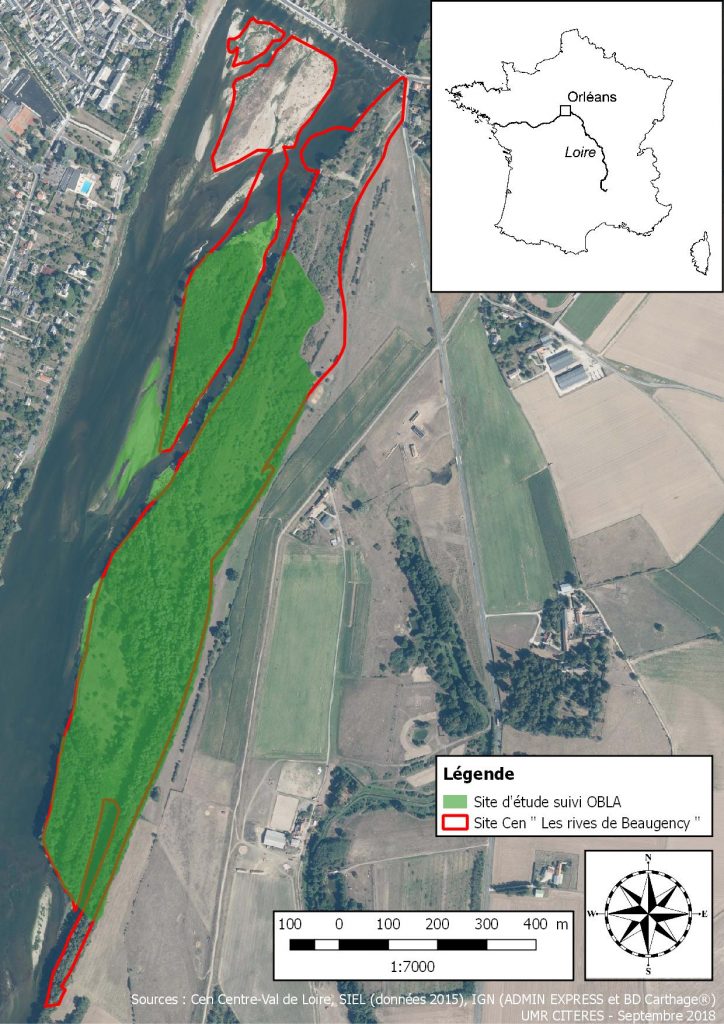
Study site location
The study site's boundaries correspond to those of the Conservatory of Natural Spaces site, with the exception of the southern tip, the northern extremity (cattle grazing), and the islets furthest upstream affected by a Biotope Protection Order (Little Terns and Ringed Plovers).
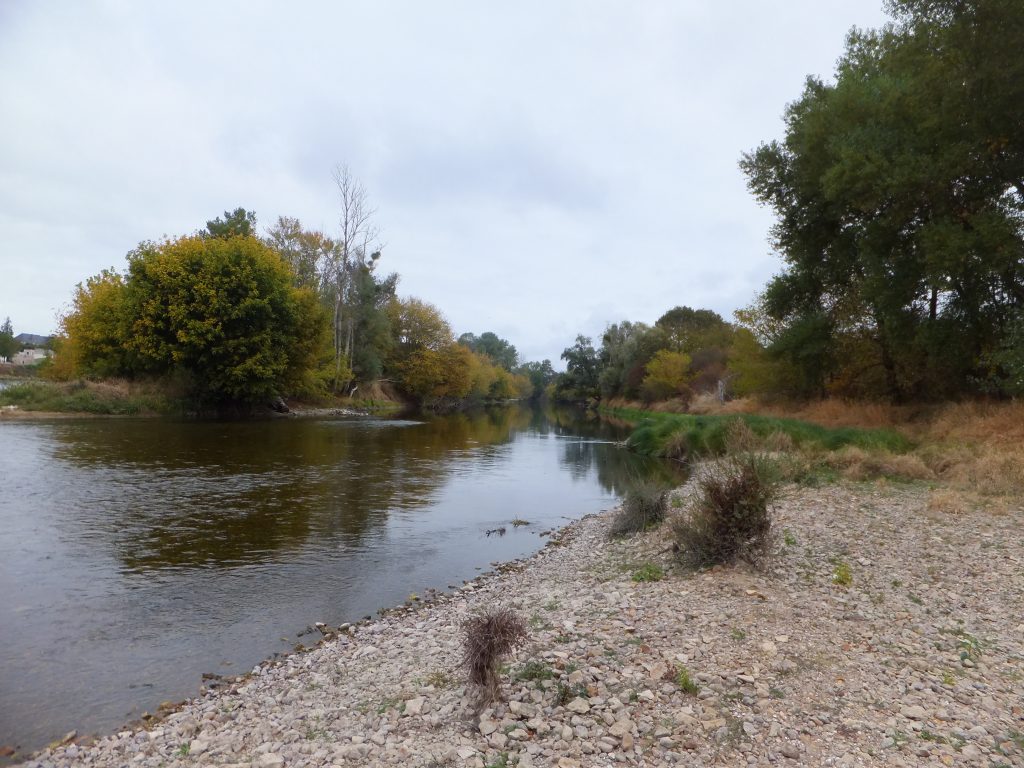
View of the channel separating the islet (on the left) from the left bank (on the right) at the study site
Studied communities
Different biological groups are studied: phytoplankton, benthic macro-invertebrates, vascular flora (aquatic macrophytes and terrestrial flora) and terrestrial arthropods (carabid beetles and spiders). The monitoring thus covers primary producers from aquatic and alluvial habitats, as well as small primary and secondary consumers. They also represent the food supply (prey) for consumers of the alluvial ecosystem operating on a broader spatio-temporal scale and not monitored here. These groups are also widely used as bioindicators for environmental quality and are also likely to host species of high conservation concern and/or exotic species.
Objectives
The objectives of these three years of protocol testing are as follows:
- Determine the composition and structure of the studied communities
- Analyse their spatial (between habitats) and temporal (intra-annual) variations
- To study the effect of environmental parameters (temperature, hydrology, water physico-chemistry, etc.) on communities
- Recommend potential protocol modifications (e.g., sampling frequency and distribution)
Resources
Interactive map of the study site:
http://carmen.carmencarto.fr/226/Suivi_Beaugency.map
Virtual tour of the "Les rives de Beaugency" site: https://www.cen-centrevaldeloire.org//Visites_virtuelles/VisiteBeaugency/LesRivesDeBeaugency.html
Website of the Centre-Val de Loire Natural Areas Conservatory: https://www.cen-centrevaldeloire.org/
Contacts:
Scientific coordinator: Sabine Greulich, UMR Université de Tours - CNRS 7324 CITERES (greulich@univ-tours.fr)
Data analysis and management: Fabien Verniest, UMR Université de Tours - CNRS 7324 CITERES (fabien.verniest@univ-tours.fr)

 English
  French